Thursday, 5 December 2013
Saeed Ajmal
Saeed Ajmal (Punjabi, Urdu: سعید اجمل; born 14 October 1977) is a Pakistani cricketer. He is a right-arm off-spin bowler who bats right handed. At domestic level in Pakistan he has represented Faisalabad, with whom he won the 2005 ABN-AMRO Twenty-20 Cup; Khan Research Laboratories; and Islamabad. Ajmal made his One Day International debut for Pakistan in July 2008 at the age of 30, and a year later played his first Test. In 2009 he was reported for having a suspect bowling action, but after being cleared he helped Pakistan win the 2009 ICC World Twenty20. Ajmal played for Worcestershire as an overseas player in English domestic cricket in 2011. Since November 2011, Ajmal has been ranked by the International Cricket Council as the number one bowler in ODIs. He is ranked at number two in ICC ranking of bowlers in T20Is, while his current ICC test bowler ranking is number 4.[1] On 28 January 2012, in his 20th Test, Ajmal became the quickest Pakistani to take 100 test wickets.[2] Saeed Ajmal holds the record of leading wicket taker(76) in Twenty20 International cricket.[3] Ajmal was signed by Adelaide Strikers for the 2012 Big Bash League in Australia.[4] Contents [hide] • 1 Domestic career • 2 International career • 3 Bowling style • 4 Dav Whatmore Controversy • 5 Bowling records • 6 References • 7 External links Domestic career[edit] Saeed Ajmal has played for Faisalabad since his debut in 1995 at the age of 18. Ajmal represented the Faisalabad Wolves in the 2005 ABN-AMRO Twenty-20 Cup, his team won the final in which he was man of the match.[5][6] When Faisalabad won the final of the ABN-AMRO Patron's Cup in March 2006 Ajmal was named the tournament's best bowler and was given a Rs 25,000 prize.[7] He has also represented Khan Research Laboratories, who were runners-up in the final of the 2008/09 Quaid-i-Azam Trophy; though his side lost the final, Ajmal took 5/105 and 2/55 and in the process passed 250 first-class wickets.[8][9] Ajmal has also played for Islamabad. International career[edit] Pakistan hosted the Asia Cup in June 2008; Ajmal was included in the 15-man squad and was expected to act as a foil to Shahid Afridi's leg spin.[10] He made his debut against India on 2 July 2008. Ajmal took a single wicket, that of Yusuf Pathan, from his ten overs while conceding 47 runs (1/47) as Pakistan won by eight wickets.[11] before taking 2/19 in a ten-wicket victory over Bangladesh, although the team had no chance of progressing to the competition's final.[12] In November that year Pakistan travelled to the United Arab Emirates to face the West Indies in a three-match ODI series. Ajmal and Afridi were the team's only spin options;[13] the former took a single wicket while conceding 73 runs and Pakistan won all three matches.[14] Ajmal's next match the third ODI against Sri Lanka in January 2009.[15] In April Pakistan faced Australia in the UAE in five ODIs. Playing in all five matches Ajmal took four wickets at an average of 39.50.[16] He was then picked for the Sri Lankan series in Sri Lanka where he had made solid performances in the Test matches, being picked ahead of Danish Kaneria in two of the matches. In April 2009, Ajmal was reported by umpires for having a suspect bowling action. An independent test the following month demonstrated that Ajmal's arm flexed within the 15 degree tolerance allowed by the International Cricket Council.[17] Later that year, the Pakistan Cricket Board named a pool of 30 players from which they would chose their final squad for the 2009 ICC World Twenty20, held in June. Initially left out, Ajmal was one of three players added to the list, replacing players who were dropped because they were contracted with the controversial Indian Cricket League.[18] In the tournament, Ajmal partnered Afridi.[19] Pakistan won the tournament,[20] and Ajmal was the tournament's joint second highest wicket-taker with twelve dismissals from seven games (only Pakistan's Umar Gul took more wickets, with thirteen dismissals).[21] Ajmal's good form continued in the 2010 ICC World Twenty20 as he was Pakistan's leading wicket taker. However despite his good form he was known for conceding three sixes to Michael Hussey in what has been hailed as the most thrilling Twenty20 match of all time as Australia were in trouble and Ajmal was the unfortunate bowler who bowled that final over.[22] Shortly after this the Pakistan team began a tour of England where they would face Australia in two Tests in July, and subsequently play England in four Tests and five ODIs. Danish Kaneria was preferred to Ajmal in the first match against Australia, but after Pakistan lost the selectors considered dropping the leg-spinner and choosing Ajmal.[23] In the event, Ajmal was not selected until the second Test against England,[24] when Kaneria was dropped because he had been ineffective. Though Pakistan lost the match by nine wickets, Ajmal took his first five-wicket haul in Tests. In Pakistan's second innings, with his team looking to set a target for England to chase, Ajmal scored 50 from 79 balls, his first half-century in Tests, before he was dismissed by fellow off spinner Graeme Swann.[25][26] During the series against England, Pakistan became engulfed in a spot fixing scandal after the fourth test. In a later secret interview it was unveiled by alleged fixer Mazhar Majeed that Ajmal, Abdul Razzaq, Younis Khan and Shahid Afridi were too difficult to bribe. He stated that Ajmal was too religious to get involved into fixing.[27] After the controversy and upheaval of 2010, 2011 saw Pakistan become a more consistent team. The year began with the World Cup held between February and April. Pakistan progressed to the semi-final, where they were defeated by India;[28] playing in three of the team's matches, Ajmal took five wickets at an average of 18.60.[29][30] After the World Cup, Pakistan played ten Tests, winning six andlosing a single match;[31] this saw the team win series against Bangladesh, New Zealand, Sri Lanka and Zimbabwe and draw with the West Indies.[28] Ajmal finished the year with 50 wickets from 8 Tests, more than any other bowler (second on the list was India's Ishant Sharma with 43).[32] Pakistan were also largely successful in ODIs, winning 24 out of 32.[28] After Pakistan beat Sri Lanka 4–1 in November 2011, Ajmal climbed to the number one spot in the ICC's ODI rankings.[33] He finished the year by taking nine wickets over two Tests in Pakistan's tour of Bangladesh.[34] Pakistan started 2012 with a three Test series against England in the United Arab Emirates. Ajmal was named the man of the match for the first Test in Dubai, with match figures of 10 wickets for 97 runs and a career best 7/55 in England's first innings.[35][36] In the second fixture he dismissed Matt Prior to become the fastest Pakistani bowler to reach 100 wickets in Tests, taking 19 matches to accomplish the feat.[37] The series concluded with Pakistan completing a 3–0 whitewash over England, and Ajmal was named man of the series after claiming 24 wickets at an average of 14.70.[38][39] In the immediate aftermath of the Test series, following confusion over comments from Ajmal about his bowling action in an interview to the BBC,[40] ESPNCricinfo published detailed information on the issue after a thorough investigation by journalist George Dobell with extensive discussion with ICC having been conducted. The resulting articles underlined the fact that Ajmal's bowling action falls well within the legal bounds set by the ICC for bowlers.[41][42] Ajmal was signed by Adelaide Strikers for the 2012 Big Bash League in Australia.[4] Bowling style[edit] “ With HawkEye coming in, left-arm spinners slide the ball on for lbws. Offspinners get a lot of lbws from round the wicket, so you [batsman] have to work really hard, and a bloke who's got a doosra you have to work extra special hard [sic]. ” —England batsman Kevin Pietersen in 2010[25] A right-arm off spinner, Ajmal's stock delivery turns into right-handed batsman but he also frequently uses the doosra which turns the other way,[25] and he generally bowls flatter than most off spinners. The doosra has been an effective tool for Ajmal as batsmen have often failed to pick it. Explaining his bowling style in 2012, Ajmal said "If I bowl with flight I cannot bowl well. If I bowl at a quicker speed I can then use variations in pace. If I take 70% of my wickets with the doosra why should I not bowl it? Whether you bowl a doosra or an offbreak, the ball should be bowled on the right line and one should take a wicket with it."[43] Dav Whatmore Controversy[edit] In reply to a question asked by a interviewer regarding difference between Local and foreign Coaches, Saeed Ajmal replied,“There is no difference, just that we are paying more to him, otherwise there is no difference,”. This prompted Dav Whatmore (SriLankan Born, Pakistan Cricket Coach) to express his feeling on saying, He is deeply upset and hurt by the comments .Ajmal however latter apologized to Dav saying he didn't meant to hurt him.[44] Bowling records[edit] Key • Date – Date the match was held. Starting date of the match for Test matches. • Overs – Number of overs bowled in that innings. • Runs – Runs conceded. • Wkts – Number of wickets taken. • Batsmen – The batsmen whose wickets were taken in the five-wicket haul. • Econ – Bowling economy rate (average runs per over). • Inn – The innings of the match in which the five-wicket haul was taken. • Result – The result for the Pakistan team in that match. • – Saeed Ajmal was selected "Man of the match". • * – 10 wickets or more taken in the match.
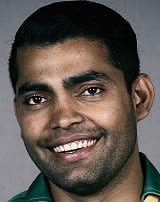
Umar Akmal
Umar Akmal (Urdu: عمر اکمل; born 26 May 1990) is a Pakistani cricketer. He made his ODI debut on 1 August 2009 against Sri Lanka and made his Test debut against New Zealand on 23 November 2009. He is a right-handed batsman and a part-time spinner. Like his two brothers, Adnan and Kamran, Umar has kept wicket for the national team.
He was announced as a Franchise Player for the inaugural Caribbean Premier League alongside Pakistani teammates Mohammad Hafeez and Shoaib Malik [1]
Contents
[hide]
• 1 Personal life
• 2 Early career
o 2.1 Australia A tour
• 3 Test career
• 4 ODI and Twenty20 career
• 5 Health Issue
• 6 Twenty20 International fifties
• 7 References
• 8 External links
Personal life
Umar is the youngest brother of Adnan Akmal and Kamran Akmal who are also cricketers, both wicket-keepers.
Early career
Umar represented Pakistan in the 2008 U/19 Cricket World Cup in Malaysia. After his success at the U-19 level he earned himself a first class contract and played the 2007-08 season of the Quaid-i-Azam Trophy, representing the Sui Southern Gas team. He is considered a future asset for Pakistan cricket. He is an aggressive style cricketer. In only his sixth first class match he smashed 248 off just 225 deliveries, including four sixes.[2] He followed that up with an unbeaten 186 in his 8th first class match, off just 170 balls. He fared less well in his second season of first class cricket, with a string of low scores batting at number 3. He found form in the final few matches of the 2008/09 season and then in the RBS T20 tournament thus getting the selectors nod to play for Pakistan A side on their tour to Australia A.
Australia A tour
Umar came to prominence during the Australia A tour in June/July 2009. In the two Test matches he recorded scores of 54, 100*, 130, 0. In the ODI series that followed Umar continued his fine form with a century in the opening ODI encounter off just 68 deliveries. These performances made him gather considerable praise from the media who were there to witness him and calls began to grow about his inclusion in the ODI series for the main Pakistan side against Sri Lanka.[3]
Test career
Umar Akmal at the University Oval, Dunedin, in 2009.
Umar made his Test debut against New Zealand at Dunedin on 23 November 2009. On the third day of his debut test, Umar Akmal hit 129 runs from 160 balls becoming only the second Pakistani to score a hundred on debut away from home after Fawad Alam. This feat also made him the first Pakistani batsman to score both his maiden Test and ODI century away from home, following his ODI century against Sri Lanka. The innings was noted as special due to Pakistan's tough position in the match and the hundred partnership which Akmal was involved in alongside his elder brother Kamran. He followed up the century in the first innings with a fifty in the second innings.
In only his second Test match he was moved up the order to the crucial spot of number 3, where he struggled initially but managed to counter-attack the hostile bowling with his natural flair, making 46 before he was undone by an inswinger by Daryl Tuffey. In the second innings he was moved down the order to his usual batting spot of number 5 as captain Mohammed Yousuf chose to bat at number 3 himself, and Akmal looked his usual aggressive self throughout his innings of 52 which came off only 33 balls. He had his first failure in the first innings of the third test at Napier where he was caught in the gully for a duck but scored a rearguard 77 in the second, promoting him to the leading run scorer of the series. Akmal finished the tour with 400 runs at an average of 57.14.
Umar Akmal's early success was briefly tarnished by a controversy during Pakistan's 2009–10 tour of Australia. It was widely reported that Umar had feigned an injury to protest the dropping of older brother Kamran for the final Test match against Australia. Umar denied such rumors and played in the final match without his brother. He was later fined 2-3 million rupees by the PCB for breaching his contract and speaking to the media without approval.[4]
ODI and Twenty20 career
In an interview, Umar said "My own dream is to one day play for Pakistan alongside Kamran Bhai (Brother) and I'm working hard to try and achieve that goal".[5] Akmal was selected in Pakistan's squad for the One Day International Series against Sri Lanka in July/August 2009. Having missed out on the first ODI Umar made his debut in the second match of the series replacing Mohammad Yousuf in the middle order. In only his second career ODI Umar scored his maiden ODI fifty. Umar followed up his maiden fifty by scoring a century in the very next match. For this match winning effort he was awarded his first career Man of the Match award.[6] His exploits in Sri Lanka earned him a place in Pakistan's champions trophy squad. He played two good innings. His 41 not out against West Indies was a match winning knock and landed him his second career Man of the Match award.[7] His next big innings came in the semi final against New Zealand, where he scored a brisk 55 in a losing effort, before he was wrongly given out by umpire Simon Taufel, who later apologized.[8] Despite the fact that Umar Akmal is not a wicket-keeper he kept wicket for Pakistan temporarily in the third ODI against England in 2010 from the 27th over onwards because his elder brother Kamran was being diagnosed for an injury to his finger. Umar Akmal scored 71 runs from 52 balls in his debut World Cup match and was named Man of the Match.[9]
In February 2012 Pakistan faced England in four ODIs. Pakistan's brittle batting meant the team management chose to play Umar as a wicket-keeper based on his batting, though his brother Adnan was considered the better 'keeper. The result of choosing the less accomplished glovesman was that in the first two matches Umar Akmal missed opportunities to dismiss Ravi Bopara and Alastair Cook early in their innings, and they respectively went on to score a half-century and a century.[10]
Health Issue
While he was playing for the Barbados Tridents, in the Caribbean Premier League, he had to spend a night in hospital after he suffered mild seizures. Following this, the PCB called him back for a complete medical checkup and also dropped him from the upcoming Zimbabwe tour. On 6 September 2013 he was cleared by a neurologist, saying that the seizure was possibly due to a lack of sleep.[11]
Kamran Akmal
Kamran Akmal (Urdu: کامران اکمل; born 13 January 1982) is a Pakistani cricketer who has played Tests, ODIs and T20Is for Pakistan as a wicket-keeper.[1] A right-handed batsman, Akmal started his international career in November 2002 with a Test match which Pakistan won at Harare Sports Club.[2] He has made 2648 runs in 53 Test matches with the help of six centuries, while in 137 ODIs, he has scored 2924 runs with the help of five centuries. In T20Is, he has scored 704 runs.[1] As a wicket-keeper, he has dismissed 206, 169 and 52 batsmen in Tests, ODIs and T20Is respectively.[1] Contents [hide] • 1 International career • 2 Match fixing allegations • 3 Wicket-keeping • 4 Personal life • 5 IPL career • 6 Records and statistics o 6.1 Test records o 6.2 ODI records • 7 References • 8 External links International career[edit] Akmal is a quick-scoring batsman and a wicket-keeper, who has achieved 6 centuries in Test innings. However, his first century was vital – his 109 from the number eight position at Mohali, coming in with Pakistan in a lead of 39 against India in the first Test, ensured that the visitors could draw the match. His form against the touring English in 2005 made him one of the most important players in the team. Naturally, he is a batsman that plays lower down the order but has sometimes opened in both Test and One-day cricket. As an opener he has scored two back to back centuries in ODIs against England. Coming in lower down the order in Test matches, he played one memorable innings. He saved Pakistan from a score of 39/6, scoring a century, to a competitive 245 which helped Pakistan win the match and the series. His batting was highly productive in early 2006 as he scored seven international hundreds within the space of 6 months. Since his tour of England in Summer 2006 however his batting form dwindled and steadily become worse. His wicket-keeping also worsened and dropped many catches on both the England tour and on a tour to South Africa in early 2007. He then scored an international hundred in the Bangladeshi tour of Pakistan in 2008. He later moved to have some injuries and did not play for some days but later he was again brought into the team. Akmal was dropped for the Asia Cup 2008 as a result of his poor wicket-keeping. He was replaced by Sarfraz Ahmed who performed very well at the domestic level and also because of Sarfraz's strong showing in the U-19 World Cup. Akmal was named in the 30 man probable squad for the 2008 ICC Champions Trophy. Akmal was part of the Pakistan team that won the T20 World Cup in 2009. He was notable for his quick stumpings, dismissing 4 batsmen in one match against Netherlands. On 12 November 2008, Akmal hit two consecutive 6s in the last over. As a result Pakistan won the first ODI in Abu Dhabi against West Indies. On 17 July 2010, Akmal was appointed the vice-captain of the Pakistani test squad but later removed because of his alleged involvement in spot fixing.[3] In August 2012, Akmal was recalled for the three ODI series against Australia.[4] Match fixing allegations[edit] In the 2nd Test match on the 2009–10 tour of Australia, Akmal dropped four catches in the Australian innings, three of those coming from Michael Hussey. Hussey went on to score 134* and was involved in a massive 9th wicket partnership stand of 133 runs with Peter Siddle. Pakistan eventually went on to lose the match by 36 runs, after being dismissed for just 139 in the second innings. Later it was alleged that he, along with pace bowler Rana Naved-ul-Hasan were involved in match fixing, and were questioned by Pakistan Cricket Board and subsequently dropped for the Twenty20 series against England.[5] In early September 2010 The International Cricket Council sent an official notice to Pakistan wicketkeeper Kamran Akmal telling him that he is under investigation for allegedly fixing the Sydney Test.[2] For the subsequent series against South Africa in October 2010 Akmal had an operation to remove his appendix and was unavailable for the limited-overs squad. Akmal was able to recover from the operation to participate in the two-match test series but Zulqarnain Haider was selected ahead of him [6] Another reason also emerged that Kamran Akmal, Shoaib Malik, Umar Amin and Yasir Hameed were not selected for the tour due to the fact that suspicions were raised that they were involved with the spot-fixing scandal that included Salman Butt, Mohammad Amir and Mohammad Asif. Another player Wahab Riaz was under investigation for fixing but the ICC had interrogated him and he was no longer part of the investigation therefore he was allowed to take part on the tour of South Africa that included two Twenty20 Internationals, five ODI matches and two Test matches. Though this has not been confirmed by the board, it is believed that the reason they were not picked was that the suspicion had not been cleared.[7] The ICC confirmed that Akmal had been barred from entering the team. Once his investigation was completed he was available for national selection.[8] Wicket-keeping[edit] Kamran Akmal has been constantly criticized for his lack of consistent wicket-keeping. After another horrendous series behind the stumps against Sri Lanka in January 2009 journalists and former players called for his removal from the national team.[9] His wicket-keeping steadily improved, with a very strong showing in the 2009 T20 World Cup, including a world-record performance of four stumpings in a single match against the Netherlands. However during the second test against Australia at the Sydney Cricket Ground he dropped four catches, including three chances from Michael Hussey in one session on Day 4. Hussey went on to score a match winning century with the Pakistan team losing in a shock result after dominating the first three days of play.[10][11] He was subsequently dropped for the third test, being replaced by Sarfraz Ahmed. After this tour Akmal saw a steady improvement in his wicket-keeping for the 2010 ICC World Twenty20, 2010 Asia Cup and against Australia in July 2010 however the next test series against England saw Akmal drop three easy catches and miss a stumping. The match as a consolation saw Akmal take a superb catch of Kevin Pietersen before dropping a catch on the very next ball against Paul Collingwood. In the first innings Akmal dropped a catch of Eoin Morgan when he was on 23 who then went on to score 130.[12] Despite having another keeper, Zulqarnain Haider, in the squad, Pakistani captain Salman Butt announced it was too early in the series as only one match had been played to decide the fate of Kamran Akmal.[13] Personal life[edit] Akmal has two brothers, Adnan Akmal and Umar Akmal, who are also professional cricketers. The former being a keeper-batsman and the latter being a batting all-rounder. He married in 2006 and lives with his wife, Aaiza, and their daughter, Laiba. He is a graduate of Beaconhouse School System Garden Town, Lahore.[14] Kamran Akmal wedding was held in 2006. He is married to Aaiza Ilyas[3]. IPL career[edit] Akmal was signed on to the Rajasthan Royals, and played in the inaugural season of the IPL. He played five matches in the tournament, as wicket-keeper and top-order batsman, including the final of the tournament against the Chennai Super Kings. He took two catches in the first innings, however he was run out for six runs during the Royal's chase. The Royals went on to win the tournament after a thrilling finish. He did not play in 2009 because Pakistani players were not selected by any IPL teams to participate that season as a result of the tense atmosphere after the 2008 Mumbai attacks.
Waqar Younis
Waqar Younis Maitla (Punjabi: وقار یونس, born 16 November 1971) is a former Pakistani right-arm fast bowler in cricket and widely regarded as one of the greatest fast bowlers of all time.[4][not in citation given] As of 2012, he holds the record for the youngest Pakistani Test captain and the third youngest Test captain in history (22 years 15 days).[5] He played 87 Tests and 262 One Day International (ODI) matches for Pakistan during his international cricket career from 1989 to 2003.[6]
Younis' trademark was his ability to reverse swing a cricket ball at high speed.[7] He took 373 Test wickets and 416 One Day International wickets during his career. Together with bowling partner Wasim Akram, he formed one of the world's most feared bowling attacks.[8] Younis has the best strike rate for any bowler with over 350 Test wickets.[9] He worked as a bowling coach with the national side from 2006 to 2007.[10] Waqar was appointed as the coach of the Pakistan cricket team on 3 March 2010.[11][12] He resigned as Pakistan's cricket coach on 19 August 2011 citing personal reasons.[13][14]He joined Sunrisers Hyderabad as their bowling coach for the Indian Premier League 2013 season.[15]
Contents
[hide]
• 1 Early and personal life
• 2 Playing career
o 2.1 Domestic
o 2.2 International
• 3 Coaching
• 4 Style
• 5 Fan following
• 6 Award and records
o 6.1 Five wickets in an innings
• 7 References
• 8 External links
Early and personal life[edit]
Waqur Younis was born in Vehari, Punjab in a Jatt Muslim family in Pakistan. He was educated in Sadiq Public School in Bahawalpur in Pakistan, the Pakistani College (Pakistan Islamia Higher Secondary School) in Sharjah and the Government College in Vehari. He was raised in Sharjah in the United Arab Emirates, where his father was a contract worker. He returned to Pakistan and started playing cricket there during his adolescent years.
He is married to Dr. Faryal Waqar Younis, a Pakistani Australian.[16] They have a son Azaan Waqar and a daughter Maira Waqar and now lives in Castle Hill in Australia.[17] Younis has also worked as a television sports commentator for the Nine Network in Australia and for Ten Sports in the United Arab Emirates.
Playing career[edit]
Waqar began his cricket career in 1987/88 Pakistan, playing for several first-class cricket clubs. However he suffered an injury when he had cut and removed his little finger on his left hand,[18] after he had jumped into a canal. He recovered from this accident and went on to continue his sporting career. He was eventually discovered by former Pakistan captain, Imran Khan and was selected to be part of the national side.[2] He had played only six first class games when he got picked for the Pakistan camp out of the blue. Waqar says "I remember Imran was not feeling well at the time, and was not present at the camp. Luckily the Super Wills Cup was going on, and there was a match between United Bank and Delhi XI. Saleem Jaffar got injured, and I got the opportunity to play that game. Imran watched me on TV, and actually came to the ground to watch the end of the game. The very next day, he met me and told me that I will be going to Sharjah next month. Just meeting Imran at the time was enough of an experience for me, but for him to notify me of my selection was just out of this world."
Domestic[edit]
English audiences became aware of Waqar's talent during the early 1990s, when he played for Surrey. By taking 113 wickets in 582 overs for Surrey in 1991, at a mere 14.65 apiece, and by carrying on his shoulders an otherwise moderate county attack, he announced himself as one of the finest contemporary bowlers.[19] There he displayed excellent cricketing performances and attracted attention from the sporting public. He went on to win the English County Championship with Glamorgan in 1997. He took 7 wickets for 25 against Lancashire at Liverpool on 21 June 1997, which included a hat-trick achieved after narrowly missing a hat-trick earlier in the innings.[20]
International[edit]
Waqar made his International cricket debut for Pakistan against India on 16 November 1989, in the same match that Indian batsman Sachin Tendulkar made his debut. Waqar took 4 wickets in the drawn match including the wickets of Tendulkar and Kapil Dev.[21] He made an immediate impression with his speed and became known in the cricket media as "Wiki"[22] or the "Burewala Express".[22] Waqar along with Wasim Akram opened the bowling attack regularly for Pakistan, becoming a feared and potent attack.[23] At his peak, he developed into a very quick fast bowler and also became famous for achieving a hat-trick in a One Day International match against New Zealand in 1994.[23] During the early periods of 2000, he stayed out of the Pakistan team for a brief period allegedly due to suspension and conflicts with bowling partner and captain Akram.[24][25]
His return to cricket came with him being appointed the captain of Pakistan.[26] However, he had to deal with allegations of ball-tampering and a number of controversies. In July 2000 Waqar was banned for ball tampering and was fined 50% of his match fee.[27] He was involved in further controversy during 2003 World Cup matches. In the opening match against Australia, Waqar was removed from the attack after bowling a beamer at Andrew Symonds, becoming the first bowler to be disciplined in such a way during an international match.[28] The Pakistanis then crashed out of the group stage after winning only two matches, both against associate member teams. After the tournament he conceded the captaincy and was dropped from international selection.[29] After a nearly 15-year career, Waqar announced his retirement from cricket altogether in April 2004. [8]
Coaching[edit]
In March 2006, he was appointed as the bowling coach for Pakistan.[30] He resigned from this position on 6 January 2007 in protest against the Pakistan Cricket Board decision to retain him only for the Test series against South Africa and not for the subsequent series of five One Day International matches.[31][32] He was re-appointed as Pakistan's bowling and fielding coach for their tour of Australia in December 2009.[33] In February 2010, Younis was appointed the head coach of Pakistan after Intikhab Alam was sacked as coach, owing to the low level of performances of the national side during the tour of Australia earlier that year.[34]
Waqar's first job as coach was to lead an inexperienced Pakistan side missing Younis Khan, Mohammad Yousuf and Shoaib Malik to the 2010 ICC World Twenty20 as a consolation, though Waqar had two top-notch bowlers in Mohammad Amir and Mohammad Asif at his disposal.[35][36] He guided the defending champions to the semi-final of the tournament before they were eliminated by Australia, whose Mike Hussey struck three sixes in the final over.[37]
The World Twenty20 was followed with the 2010 Asia Cup in which Pakistan lost to Sri Lanka by a narrow margin as Pakistan's top order collapsed and Shahid Afridi's 109 just failed to guide Pakistan to victory.[38] In the following match Pakistan lost narrowly against India courtesy of a six by Harbhajan Singh from the third ball of the final over.[39] The following match was a dead rubber between Pakistan and Bangladesh and another Afridi century meant Pakistan scored 385 runs and they comfortably won the match by 139 runs[40]
A tour of England followed, with two Twenty20's against Australia and two Test matches. Pakistan won both Twenty20's comfortably and the first Test saw Pakistan defeated by 154 runs. Pakistan rallied in the second Test and for the first time in 15 years Pakistan defeated Australia in a Test match. The previous victory in 1995 was also assisted by a superb bowling spell by Waqar Younis.[41]
This tour was followed by a controversial tour of England as Pakistan headed in to the final Test match needing to win it to level the series 2–2. The News of the World broke the news that Mohammad Amir, Mohammad Asif and captain Salman Butt were involved in Spot-fixing.[42] This saw the three players temporarily suspended[43] and Pakistan lost by an innings and 225 runs – their biggest defeat in history.[44] Low team morale meant the next two T20 matches were won comfortably by England, and the subsequent ODI series was won 3–2 by England as well.[45]
This was followed by a tour of Abu Dhabi against South Africa. Pakistan lost the first Twenty20 match by six wickets following a batting collapse. Pakistan also lost the ODI series of five matches 3–2.[46] Pakistan won the second ODI due to Abdul Razzaq's superb performance of 109* off 72 balls.[47] The Test series of two matches with South Africa was drawn. He also stated that now it was the time for Pakistan to rally and prepare for the World Cup.[48]
In March 2013 it was announced that he would join Sunrisers Hyderabad as their bowling coach for the Indian Premier League 2013 season.[49]
Style[edit]
Waqar is one of several Pakistani fast bowlers, beginning with Sarfraz Nawaz, who have been successful at bowling reverse swing.[7][50] In partnership with Akram, Younis opened the Pakistan bowling attack in the 1990s. Cricket critics and scholars attribute Younis and Akram to be one of the most effective fast bowling partnerships in cricket, due to their ability to swing the ball at high speed. The ability to reverse swing and his speed led to him becoming one of the most talented bowlers in modern cricket.[2][23]
Waqar explained his ability to reverse swing by the manipulation of an old ball; with one side shiny, one side rough, the ball would move in the opposite direction to conventional swing.[7] This led to Waqar having the ability to bowl inswingers and outswingers in the cricket pitch and in effect both Waqar and Akram became successful in taking wickets by this variation of swing bowling.[50][51][52] His fastest delivery in cricket was 153 km/h or 95.1 mph, a delivery he bowled against South Africa in 1993.[53][54] He was also effective in the use of bouncers or short pitch deliveries; Waqar's bowling against South Africa in Sheikhupura in Pakistan, is remembered for his effective use of the short pitched delivery.
Following Pakistan's victory during the Test match series versus England in 1992, the English media were suspicious of the reverse swing delivery. It was relatively unknown to the cricketing world during that period and this led to accusations of foul play by critics, however cricket officials found no evidence of foul play and the skill of the reverse swing delivery has been accepted in cricket.[55][56][57][58]
Sri Lanka fast bowler, Lasith Malinga, who became the first bowler in World Cup history to take two hat-tricks, has said that he learnt to bowl his deadly yorkers by watching Pakistan's legendary pair of Wasim Akram and Waqar Younis.[59][60][61] No doubt over the years several bowlers have learned and mastered the skill of reverse swing but there are still some techniques which haven't have been explored, e.g. banana swing. The title of Banana Swing Bowler was given to Waqar Younis because of his unique technique of swinging the ball in the air at very high speed before hitting the ground. In most of his hat tricks he has delivered banana swing balls which were unplayable.[57]
Despite his qualities as a fast bowler, he was expensive at times and sometimes lacked the consistency of bowlers such as West Indian fast bowler Curtly Ambrose and Australian fast bowler Glenn McGrath. This may be partly due to the mentality of his former captain, Imran Khan, who prioritised aggression and speed.[2]
Fan following[edit]
The world's fastest sprinter and runner Usain Bolt, who is from Jamaica (in the West Indies), once famously replied while being asked about who were his heroes when he was a child: "When I was really small I loved the Pakistan cricket team. Waqar Younis was one of the greatest bowlers ever, and I was a bowler so I really enjoyed watching him. I was a big Pakistan fan until I got older, when I noticed that I should actually support my home team." When asked what if there was a match between Pakistan and Windies, Bolt remarked "I would still have supported Pakistan, that’s what I’m saying – when I was little, it was all about Pakistan."[62][63]
Award and records[edit]
Waqar was named among the Wisden Cricketers of the Year[19][64] in 1992 for his sporting achievements. He is also the only bowler to have taken 5 wickets in an innings in 3 consecutive One Day International matches. In terms of deliveries bowled, he has taken the fastest 50, 300, 350 and 400 wickets in One Day International matches and the fastest 150, 200, 250, 300 and 350 wickets in Test matches.
Although primarily a fast bowler, Waqar scored 1010 Test match runs during his career. As of September 2005, he was the only non-batsman to achieve a thousand runs without scoring a fifty.[65][66] Waqar holds the record for the best strike rate for any bowler with over 350 Test wickets.[9]
Five wickets in an innings[edit]
See also: List of international cricket five-wicket hauls by Waqar Younis
Waqar Younis has taken five or more wickets in an innings on 22 occasions in Test cricket.[67] In One Day International matches, he has taken the most number of five-wicket hauls (on 13 occasions).[68]
Wasim Akram
Wasim Akram (Urdu: وسیم اکرم; born 3 June 1966) is a former Pakistani cricketer. He was a genuine left arm fast bowler who could bowl with significant pace and left-handed batsman who represented the Pakistan national cricket team in Test cricket and One Day International (ODI) matches.In October 2013,Wasim Akram was the only Pakistani cricketer to be named in an all-time Test World XI to mark the 150th anniversary of Wisden Cricketers' Almanack.[1][2][3][4] Akram is regarded as one of the greatest fast bowlers in the history of cricket. He holds the world record for most wickets in List A cricket with 881 and is second only to Sri Lankan off-spin bowler, Muttiah Muralitharan in terms of ODI wickets with 502. He is considered to be one of the founders and perhaps the finest exponent of reverse swing bowling. Akram had a very special talent to move the ball both ways in one delivery which is called "double swing of Wasim Akram". No one in cricket history has done it so far.[5][6][7] He was the first bowler to reach the 500-wicket mark in ODI cricket during the 2003 World Cup. In 2002 Wisden released its only list of best players of all time. Wasim was ranked as the best bowler in ODI of all time with a rating of 1223.5, ahead of Allan Donald, Imran Khan, Waqar Younis, Joel Garner, Glen McGrath and Muralitharan.[8] Wasim has taken 23 4-wicket hauls in ODI in 356 matches he played.[5] On 30 September 2009, Akram was one of five new members inducted into the ICC Cricket Hall of Fame.[9][10] He is the bowling coach of Kolkata Knight Riders.[11] but took a break from the position for IPL 6 citing a need to spend more time with family.[12] Contents [hide] • 1 Early and personal life • 2 International career o 2.1 First-class cricket o 2.2 Test cricket o 2.3 One Day International o 2.4 1983–91 o 2.5 1992–97 o 2.6 1998 to the 2003 World Cup • 3 Records • 4 Post retirement o 4.1 Media career o 4.2 Coaching career • 5 Legacy o 5.1 Modeling • 6 Award and records • 7 Cricket controversies • 8 References • 9 External links Early and personal life[edit] Wasim Akram was born in Lahore in a Punjabi family on 3 June 1966.[13] He was educated at Government Islamia College Civil Lines Lahore, where he played as an opening bowler and batsman.[14] Like several other Pakistani cricketers during the 1980s, his inclusion into the national side was at the behest of a senior player in the team, which in Akram's case, was Javed Miandad.[15] At the age of 30, Akram was diagnosed with diabetes. "I remember what a shock it was because I was a healthy sportsman with no history of diabetes in my family, so I didn't expect it at all. It seemed strange that it happened to me when I was 30, but it was a very stressful time and doctors said that can trigger it."[16] Since then he has actively sought to be involved in various awareness campaigns for diabetes.[17] Akram married Huma in 1995.[18] They had two sons Tahmoor (born 1996) and Akbar (born 2000)[19] from their marriage of fifteen years. Huma died of multiple organ failure at Apollo Hospital in Chennai, India on 25 October 2009.[20] On 7 July 2013, it was reported that Akram had become engaged to Melbourne woman Shaniera Thompson, whom he had met while on a visit to Melbourne in 2011.[21] Wasim Akram married his Australian girlfriend, Shaniera Thompson on August 12, 2013, saying he has started a new life on a happy note."I married Shaniera in Lahore last week in a simple ceremony and this is the start of a new life for me, my wife and for my kids".[22] International career[edit] First-class cricket[edit] In 1988 Akram signed for Lancashire County Cricket Club in England. From 1988 to 1998, he opened their bowling attack in their ECB Trophy, Benson and Hedges Cup and National League tournaments. He was a favourite of the local British fans who used to sing a song called "Wasim for England" at Lancashire's matches. In 1998, with Akram as captain, Lancashire won the ECB Trophy and Axa League and finished second in the championship tournament despite losing only five matches in all competitions throughout the season.[23] Test cricket[edit] Akram made his Test cricket debut for Pakistan against New Zealand in 1985[24] and in his second Test match, he claimed 10 wickets.[25] A few weeks prior to his selection into the Pakistan team, he was an unknown club cricketer who had failed to make it even to his college team. He came to the trials at Gaddafi Stadium in Lahore in Pakistan, but for the first two days he did not get a chance to bowl. On the third day he got a chance; his performance convincing Javed Miandad to insist upon his inclusion in the national team.[15] Akram was hence given an opportunity to play for Pakistan, without any significant domestic experience. Akram's rise in international cricket was rapid during the late 1980s. When Pakistan toured the West Indies in 1988, he looked to be the fastest bowler between the two sides. However, a groin injury impeded his career in the late 1980s. Following two surgeries, he re-emerged in the 1990s as a fast bowler who focused more on swing and accurate bowling.[26] One Day International[edit] Akram started his ODI career against New Zealand in Pakistan in 1984 under the captaincy of Zaheer Abbass.[27] He rose to prominence taking five wickets in his 3rd ODI against Australia in the 1985 Benson & Hedges World Championship. His wickets included those of Kepler Wessels, Dean Jones and captain Allan Border.[28] 1983–91[edit] In the 1984–85 Rothmans Four-Nations Cup and the 1985–86 Rothmans Sharjah Cup he took five wickets with a run rate of under 3.50. The 1985–1986 Austral-Asia Cup involved Australia, India, New Zealand, Pakistan and Sri Lanka, and was played in UAE Sharjah. Akram, with the help of Abdul Qadir, bowled out New Zealand's batting line up for 64 in the second semi final of cup. Pakistan won that game with more than 27 overs to spare obtaining one of the biggest wins in Pakistani history. In the final against India he and Imran shared five wickets. Akram's wickets included Dilip Vengsarkar and Ravi Shastri. In the 1987 Reliance World Cup held for the 1st time in the sub-continent, Akram struggled on Pakistani pitches where he managed only 7 wickets with an average of over 40 in 7 matches. Akram played West Indies, Sri Lanka and England twice. All group matches were played in Pakistan. In the 1988–89 Benson and Hedges World Series he managed figures of 4–25 against Australia.[29] He took his hundredth wicket at Sharjah in 1989–1990 Champions Trophy – 2nd Match against West Indies. His 100th wicket was of Ambrose. In that match he took a five-wickets haul for the second time in his career.[30] In the same match he took his first hat-trick against West Indies. All three batsman were bowled.[30][31][32] On 4 May 1990 in Sharjah, Akram took his second ODI hat-trick against |Australia. All three batsmen were bowled this time also.[31][33] His best years in late 1980s were from 1986–1989 when which he took 100 wickets at 22.71 apiece and economy rate of less than 3.9 run/over with four 4-wicket hauls. His first two hauls against Sri Lanka and Bangladesh came in Sri Lanka in 1986.[34] Up to December 1991 Akram took 143 wickets in 107 matches with an average of almost 24 and economy rate of 3.84.[26] 1992–97[edit] Akram was a significant figure in the 1992 Cricket World Cup held in Australia, when Pakistan won the tournament. In the final against England, his batting performance during his innings of 33 runs off 18 balls, pushed Pakistan to a score of 249 runs for 6 wickets. Akram then took the wicket of Ian Botham early on the English batting innings and when brought back into the bowling attack later on, with the ball reverse swinging, he produced a spell of bowling which led to Allan Lamb and Chris Lewis being bowled in successive deliveries in one over. His performances earned him the Man of the Match award for the final.[35][36] In 1993 Akram took 2 consecutive 4-wicket hauls against Sri Lanka in Sharjah in which 7 out of 8 wickets were either LBW or bowled.[37] In the 1992–1993 Total International Series in South Africa (involving Pakistan, West Indies and South Africa) he took 5 wickets against South Africa and got his 200th wicket in his 143rd match.[38][39][40] Akram took 46 wickets in calendar year 1993, his best year ever in ODI. His average which was less than 19 with an economy rate of less than 3.8 runs per over. He took six 4-wicket hauls in 1993, the most by him in any year.[40] In the 1996 World Cup he missed the quarter final match against India which Pakistan lost and went out of the World Cup. Wasim's great career was often tainted by controversy, not least in the Caribbean in April 1993, his maiden tour as Pakistan's captain. During the team's stop-over in Grenada, he was arrested along with three team-mates - Waqar Younis, Aqib Javed and Mushtaq Ahmed - and two female British tourists, and charged with possession of marijuana.[41] Between 1994 and 1996 he took 84 wickets in 39 matches.[40] From January 1992 to December 1997 Akram played 131 matches took 198 wickets at an average of 21.86 with 14 4-wicket hauls in ODIs.[26] 1998 to the 2003 World Cup[edit] In 1999, he led Pakistan to the brink of victory in the World Cup before they capitulated and was defeated by Australia in the final, by eight wickets with almost 30 overs to spare.[42] This was the start of the match fixing controversies, as critics believed Akram had set up the match for Australia. However, none of the allegations could be proved.[43][44] He was Pakistan's best bowler in the 2003 Cricket World Cup taking 12 wickets in 6 matches.[45] However, Pakistan failed to reach the super six of the tournament and Akram was one of the eight players to be sacked by the Pakistan Cricket Board as a result.[46][47] Records[edit] Akram won 17 Man-of-the-Match awards in 104 tests. He took 4 hat-tricks in International cricket – two in ODIs.[30][33] and two in Tests,[48][49] He finished with 22 Man-of-the-Match awards in ODIs. In 199 ODI match wins, he took 326 wickets at under 19 apiece with a run rate of 3.70 and took 18 four-wicket hauls.[26] His 257 not-out against Zimbabwe in 1996 is the highest innings by a number 8 batsman in tests. He hit 12 sixes in that, most by anyone in a test innings.[50] Prior to his retirement, he was one of eight senior players dropped for the Sharjah Cup in April 2003, and was then omitted from the Pakistan squad for the subsequent Bank Alfalah Cup triangular series.[51] Due to his omission from the team, he did not participate in a farewell match. Akram fulfilled his contract play for Hampshire until the end of the English season.[52] Post retirement[edit] Media career[edit] Since retiring from cricket, Akram has worked and taken up commentary for television networks and can currently be seen as a sports commentator for ESPN Star Sports and ARY Digital among others. He did commentary on a variety of sporting tournaments including the 2009 Women's Cricket World Cup in Australia, the 2009 ICC World Twenty20 in England, the 2009 ICC Champions Trophy in South Africa, and the 2011 ICC World Cup in India, Sri Lanka and Bangladesh. Coaching career[edit] In 2010, Akram was appointed the bowling coach consultant of Kolkata Knight Riders, the Indian Premier League team for Kolkata. Sourav Ganguly was always keen to have Akram as the bowling coach for India, during the former's stint as Indian captain. Although this never happened, his dreams were realised to some extent, when Akram was appointed as the bowling coach for the franchise.[53] While working for the Kolkata Knight Riders, he was also responsible for the signing of Pakistani domestic left-arm fast-bowler Mohammad Irfan.[54] Akram has also been coaching in Pakistan fast bowling camps, his most notable discovery being the teenage Pakistani bowler Muhammad Amir. Legacy[edit] “ Over my 15 or 16 years of playing international cricket in Tests and One Day Internationals, Wasim Akram is definitely the most outstanding bowler I've ever faced. ” — Former West Indies batsman Brian Lara.[55] During his professional career he bowled with genuine speed and hostility. Akram was a man possessed of accurate control of line and length, accompanied by seam and swing bowling skills, extended to both inswingers and outswingers. With a very quick bowling action, he could bowl equally well from both sides of the wicket. His mastery of reverse swing with the cricket ball meant he was at his most dangerous towards a bowling innings, and earned him the nickname of one of the "Sultans of Swing", the other one being Waqar Younis. “ "The one player who really stood out for me was Wasim Akram. It was in that tournament[1992 World Cup] that we realised just what a special talent he was and how much trouble he was going to give us and the rest of the world in the years to come. What a player he was." ” — Former English Allrounder Ian Botham.[56] As well as often being able to find the edge of the bat, Akram would also focus his bowling attack on the stumps and had a particularly lethal inswinging yorker. Of his 414 Test wickets, 193 were taken caught, 119 were taken leg before wicket and 102 were bowled.[57][58][59] In partnership with Waqar Younis, he intimidated international batsmen in the 1990s. Together Wasim and Waqar, known as "the two Ws" of the Pakistani team, were one of the most successful bowling partnerships in cricket.[60] Akram was also skilled with the bat and was regarded as a bowling all-rounder. He was especially effective against spin bowlers. However, he liked to slog and was criticised for his lack of high scores and giving away his wicket too cheaply for a player of his talent. He did silence his critics and the media in October 1996 when he scored 257 runs not out, of the team's total of 553 against Zimbabwe at Sheikhupura. He also achieved good scores for the Pakistan team such as his scores of 123 and 45* against Australia to take Pakistan to victory in a low scoring match. His batting was also valuable to the Pakistan ODI side, such as his match winning performance in the Nehru Cup, when needing six runs and two balls to win the match; he hit the first delivery he faced for six runs and secured the cup. In December 2012 after Ricky Ponting announced his retirement he admitted that Wasim Akram along with Curtly Ambrose were the toughest bowlers he had faced[61] “Akram for the exact opposite, you could get a few runs off him, but you just knew there was an unplayable ball around the corner, be it with an old ball or with a new ball,” – Ricky Ponting [62] Modeling[edit] Akram walked the ramp at the Pantene Bridal Couture Week 2011 which was an event of Style 360.[63][64] Award and records[edit] See also: List of international cricket five-wicket hauls by Wasim Akram Akram was awarded Wisden Cricketer of the Year in 1993 for his sporting achievements. He was awarded Lux Style Award for Most Stylish Sports Person in 2003. • In his Test career, Akram took 414 wickets in 104 matches, a Pakistani record, at an average of 23.62 and scored 2,898 runs, at an average of 22.64.[65] • In One Day Internationals, Akram took 502 wickets in 356 appearances, at an average of 23.52 and scored 3,717 runs, at an average of 16.52.[6] • Akram was the first bowler in international cricket to take more than 400 wickets in both forms of the game and only Muttiah Muralitharan has since achieved this.[6][65] • Akram also held the record for the most wickets in Cricket World Cups, a total of 55 in 38 matches. Australia's Glenn McGrath broke the record during the 2007 Cricket World Cup, ending with a final tally of 71 from 39 matches.[66] On passing Wasim's record, McGrath said, "Wasim Akram, to me, is one of the greatest bowlers of all time. Left-armer, swung it both ways with the new ball and he was so dangerous with the old ball. To go past him is something I will always remember. Probably the other side of the coin is that if you play long enough, you're going to break records here and there."[67] • Akram took four hat-tricks in international cricket, two each in Tests matches and One Day Internationals. He is the only bowler in cricket to have achieved four hat-tricks. He was the third of only three bowlers to have taken two Test cricket hat-tricks, the others being Hugh Trumble and Jimmy Matthews. Akram was also the first of only five bowlers to have taken two One Day International cricket hat-tricks. Akram's Test hat-tricks are significant, since they were taken in consecutive Test matches in the same series, a game played against Sri Lanka in the 1998-99 Asian Test Championship. Akram is also one of only two bowlers to have taken both a Test match and One Day International hat-trick, the other being Pakistan fast bowler, Mohammad Sami.[68][69] • Playing in a Test series against the West Indies at Lahore in 1990–1991, he became one of only six players to have taken four wickets in an over during a Test match. In Akram's case, these achievement was not part of a hat-trick, the third ball he delivered to the batting opposition was a dropped catch, which allowed a single run.[70][71] • Akram has also achieved the highest score by a number eight batsman in Test cricket when he scored 257 runs not out from 363 balls against Zimbabwe at Sheikhupura. The innings contained 12 sixes which is also a world record for Test cricket.[72][73] • He also has the third highest number of Man of the Match awards in Test cricket, with seventeen.[74] • He has scored the record number of runs in One Day International matches by a player who has never scored a One Day International hundred. His highest score was 86 runs.[75] • He is the only Test cricketer in the world(as of Feb 2013) to take ten or more wickets thrice in a test match and still end up on the losing side [76] Cricket controversies[edit] In 1992, after he had been successful against the English batsmen, accusations of ball tampering began to appear in the English media, though no video evidence of foul play was ever found. Akram and Younis had been able to obtain prodigious amounts of movement from both new and old cricket balls. The skill of the reverse swing delivery was relatively unknown in England and around the cricketing world during that period. A far larger controversy was created when critics alleged that he was involved in match fixing. An inquiry commission was set up by the Pakistan Cricket Board headed by a Pakistan high court judge, Malik Mohammad Qayyum. The judge wrote in his report that:[77] This commission feels that all is not well here and that Wasim Akram is not above board. He has not co-operated with this Commission. It is only by giving Wasim Akram the benefit of the doubt after Ata-ur-Rehman changed his testimony in suspicious circumstances that he has not been found guilty of match-fixing. He cannot be said to be above suspicion.
Salman Butt
Salman Butt (Punjabi/Urdu: سلمان بٹ, Salmān Baṭṭ; born 7 October 1984) is a Pakistani cricketer who was jailed for his misconduct in 2011, and a regular Test and ODI left-handed opening batsman. He made his Test debut on 3 September 2003 in the third Test against Bangladesh, and a year later, made his ODI debut against West Indies on 22 September 2004. He was appointed captain of the Pakistan Test squad on 16 July 2010. On 29 August 2010, he was implicated in allegations of spot-fixing. On 31 August 2010, he was stripped of the Pakistan captaincy, and removed from the ODI Squad pending criminal proceedings. As of 5 February 2011, Butt is serving a 10-year ban, of which five years is a suspended sentence.[1] In November 2011, Butt was convicted and jailed for 30 months for conspiracy charges relating to the spot-fixing, along with Mohammad Amir and Mohammad Asif.[2] On June 21, 2012, he was released from Jail. Contents [hide] • 1 Career o 1.1 Early career o 1.2 International cricket o 1.3 Appointment as Test captain o 1.4 Spot-Fixing Scandal • 2 Playing style • 3 Test centuries • 4 One Day International centuries • 5 See also • 6 References • 7 External links Career[edit] Early career[edit] Salman started in the Under-17s and quickly progressed through Under-19 level, although at that time he was much younger than the age limits suggest, making his senior debut for Lahore Whites in 2000 aged only 19. His talent was noticed immediately, which led to him being given a place in the Pakistan A team against England soon after. However, instead of rushing straight for the limelight of international cricket, he got his head down and consolidated by playing consistently for his region and the youth teams, until the Pakistan selectors finally drafted him in 2003.[3] International cricket[edit] After his debut, Butt was dropped, and he struggled to regain his place due to some stiff competition for the openers' spots. He returned for the Champions' Trophy in 2004 and scored his first fifty for Pakistan in the Paktel Cup against Sri Lanka. In the ODI against India on 13 November 2004, as Pakistan chased down 292, he formed partnerships first with Shoaib Malik, putting on 113, and subsequently with Inzamam-Ul-Haq. Despite having retired for seven overs due to severe cramp, he returned to steer Pakistan home, finishing on 108 not out.[4] Yet 2005 saw little improvement, and doubts circulated about his defensive technique, causing him to be shuffled in and out of the side. But things started looking up again during the winter Test series against England, in which he scored a century and two fifties, with a more cautious attitude to his innings building than he had previously shown.[5] Appointment as Test captain[edit] On 17 July 2010, the Pakistan Cricket Board appointed Butt as captain of the Pakistani Test squad in place of Shahid Afridi, who announced his retirement from Test cricket after Pakistan lost the first test match against Australia.[6] He became the 28th captain of the Pakistani Test team and the fifth to lead them since January 2009.[6] On 23 July 2010, Salman Butt led Pakistan to victory against Australia in his first appearance as Pakistan's test team captain. Spot-Fixing Scandal[edit] Main article: Pakistan cricket spot-fixing controversy In August 2010, Butt and two other players, Mohammad Amir and Mohammad Asif, were among those named by a News of the World sting where undercover reporters paid an agent loosely affiliated with several players on Pakistan's squad a bribe in return for detailed information on when no-balls would be deliberately bowled. Butt, Amir, and Asif were dropped from Pakistan team for the limited-over series (two Twenty20 games, and five ODI games). However, on 2 September 2010, after the warm-up List A game between Pakistan and Somerset, the International Cricket Council announced that they had suspended Asif, Amir and Butt under the provisions of the ICC's Anti-Corruption Code. The statement from the ICC stated that the three players were charged "under various offences under Article 2 of the ICC Anti-Corruption Code for Players and Player Support Personnel relating to alleged irregular behaviour during, and in relation to, the fourth Test between England and Pakistan at Lord's last month".[7] Later it became known that Butt and the other two players implicated in the scandal were in possession of bills with the same serial numbers as those the reporter had paid Majeed earlier. Butt was provisionally suspended from playing International Cricket due to the fact that the ICC wanted his name cleared before he resumes playing cricket. In late September, Butt filed an appeal to the ICC asking them to lift his temporary suspension.[8] After Mohammad Asif had dropped his appeal against the charges so that he could understand the charges filed against him, Butt said he was determining to prove his innocence and that his appeal was going to go ahead.[9] In an interview with the Associated Press, Butt stated "I do not want to comment on The News of the World because everybody knows what kind of paper it is. Everybody knows about its reputation across the world." He also stated that he was linked to Mazhar Majeed as a player agent but not in any spot-fixing. He also stated that the video can easily be edited and modified and manipulated.[10] One day before the hearing, Butt continued to state his innocence.[11] The tribunal announced that a verdict on the decision had been deferred to 5 February 2011 and that the ICC also stated that the tribunal would rule on charges pertaining to the third Test match between England and Pakistan. Butt was the only player before the tribunal to face these additional charges.[12] On 5 February 2011, the three-man tribunal delivered its verdict. One charge was dismissed against Butt from the third Test match (batting out a maiden over), but the other charges (failing to report an advance from the third Test match and ordering Asif and Amir to bowl no-balls in the fourth Test) were proved, and Butt was banned from the sport of cricket for ten years, five of which were suspended should he not commit any further offences and participate in a Pakistani Cricket Board anti-corruption program.[13] Playing style[edit] An accumulator, he works very hard for scoring runs, not indulging in too many big hits; his statistics showing a low amount of nineteen international sixes to date (1 September 2010) of which he's scored 10 in Twenty20 cricket 7 in One-Day International and only has one six to his name in Test cricket.[14] He scores a lot of his runs between backward point and extra cover. He uses his superb wrist work to angle the bat, placing the ball into gaps using the pace of the ball to his advantage; a very good technique for ODIs where it is best to keep the scoreboard ticking all the time. He also has the ability to cut the ball very fine down to third man if there are no slips, especially against spin bowlers, as he showed to great effect in his above-mentioned innings of 108 not out. These are his specialties, but he has large range of shots. However, many commentators have expressed that his defensive technique has flaws, and that he is prone to playing at balls outside off-stump which should be left.[15]
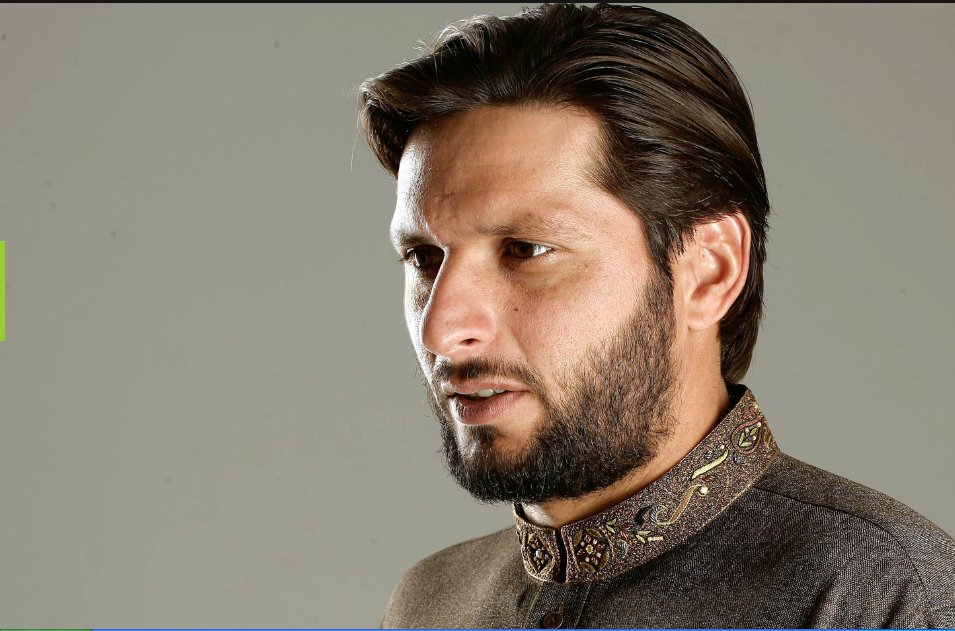
Shahid Afridi
Shahid Afridi (Urdu: شاہدآفریدی), born Sahibzada Mohammad Shahid Khan Afridi (Urdu: صاحبزادہ محمد شاہد خان آفریدی born on 1 March 1980)[2] is a Pakistani cricketer. Between 1996 and 2012, Afridi played 27 Tests, 350 One Day Internationals, and 59 Twenty20 Internationals (T20Is) for the Pakistani national team. He made his ODI debut on 2 October 1996 against Kenya and his Test debut on 22 October 1998 against Australia. He is known for his aggressive batting style,[3] and holds the record for the fastest ODI century which he made in his first international innings, as well as scoring 32 runs in a single over, the second highest scoring over ever in an ODI.[4] He also holds the distinction of having hit the most number of sixes in the history of ODI cricket.[5] Afridi considers himself a better bowler than batsman, and has taken 48 Test wickets and over 350 in ODIs. Currently Afridi is third on the list of leading wicket takers in the Twenty20 format, behind Saeed Ajmal and Umer Gul of Pakistan, taking 62 wickets from 56 matches.[6] Shahid Afridi has signed to play for Sydney Thunder in Australia’s Twenty20 Big Bash league.[7] In June 2009, Afridi took over the Twenty20 captaincy from Younus Khan, and was later appointed ODI captain for the 2010 Asia Cup. In his first match as ODI captain against Sri Lanka he scored a century however Pakistan still lost by 16 runs. He then also took over the Test captaincy but resigned after one match in charge citing lack of form and ability to play Test cricket; at the same time he announced his retirement from Tests. He retained the captaincy in limited-overs form of the game and led the team in the 2011 World Cup. In May 2011, having led Pakistan in 34 ODIs, Afridi was replaced as captain. Later that month he announced his conditional retirement from international cricket in protest against his treatment by the Pakistan Cricket Board (PCB). However, in October he reversed his decision. UNICEF and Pakistani authorities have taken Shahid Afridi on board for its anti-polio campaign in the tribal belt of lawless Waziristan region.[8] Contents [hide] • 1 Biography o 1.1 Background • 2 International career o 2.1 Captaincy (2009–2011) o 2.2 Conditional retirement and return (2011) • 3 Playing style o 3.1 Batting o 3.2 Bowling • 4 Records and achievements o 4.1 Test centuries o 4.2 ODI centuries o 4.3 ODI five-wicket hauls • 5 See also • 6 References • 7 External links Biography Background Afridi was born on 1 March 1980 in Khyber Agency of the Federally Administered Tribal Areas, Pakistan. He is from the Afridi tribe of Pashtuns.[2] Afridi is married to Nadia and has four daughters.[9] International career In October 1996 at the age of sixteen Afridi was drafted into the ODI team during the four-nation Sameer Cup 1996–97 as a leg spinner as a replacement for the injured Mushtaq Ahmed.[10] He made his debut on 2 October against Kenya, however he didn't bat and went wicketless.[11] In the next match against Sri Lanka, Afridi batted at number three in the role of a pinch-hitter. In his first international innings, Afridi broke the record for fastest century in ODI cricket, reaching his hundred from 37 balls. The eleven sixes he struck also equalled the record for most in an ODI innings.[12][nb 1] Aged 16 years and 217 days, Afridi became the youngest player to score an ODI century.[14] Pakistan posted a total of 371, at the time the second-highest in ODIs, and won by 82 runs; Afridi was named man of the match.[12] Two years after appearing on the international scene, Afridi made his Test debut in the third game of a three-match series against Australia on 22 October 1998.[15] By this point he had already played 66 ODIs, at the time a record before playing Tests.[16] He opened the batting, making scores of 10 and 6, and took five wickets in the first innings.[15] He played his second Test the following January during Pakistan's tour of India; it was the first Test between the two countries since 1990.[17] Again opening the batting, Afridi scored his maiden Test century, scoring 141 runs from 191 balls. In the same match he also claimed three wickets for 54 runs.[18] After winning the first match by 12 runs, Pakistan lost the second to draw the series.[19] In 2001, Afridi signed a contract to represent Leicestershire. In five first-class matches he scored 295 runs at an average of 42.14, including a highest score of 164,[20] and took 11 wickets at an average of 46.45;[21] Afridi also played 11 one day matches for the club, scoring 481 runs at an average of 40.08[22] and taking 18 wickets at 24.04.[23] His highest score of 95 came from 58 balls in a semi-final of the C&G Trophy to help Leicestershire beat Lancashire by seven wickets.[24] Derbyshire County Cricket Club signed Afridi to play for them in the first two months of the 2003 English cricket season.[25] In June 2004 Afridi signed with English county side Kent to play for them in three Twenty20 matches and one Totesport League match.[26] An innings-by-innings breakdown of Afridi's Test match batting career up to 30 December 2007, showing runs scored (red bars) and the average of the last ten innings (blue line) Afridi made his presence felt in the third Test against India in March 2005, scoring a quick-fire second-innings half-century and taking five wickets in the match (including Tendulkar twice) to help Pakistan to win the game and register a series draw.[27] In April Afridi struck what at the time was the equal second-fastest century in ODIs; he reached 100 off 45 deliveries against India, sharing the record with West Indian Brian Lara.[28] Afridi was more consistent with his batting and bowling throughout 2005, starting with the tours of India and West Indies and through to the England tour. The Pakistani coach Bob Woolmer helped Afridi to reach a fuller potential by improving his shot selection and giving him free rein over his batting attitude. On 21 November 2005, Shahid Afridi was banned for a Test match and two ODIs for deliberately damaging the pitch in the second match of the three-Test series against England. Television cameras pictured him scraping his boots on the pitch scuffing the surface when play was held up after a gas canister exploded. Afridi later pleaded guilty to a level three breach of the ICC code of conduct relating to the spirit of the game. Match referee Roshan Mahanama said: "This ban should serve as a message to players that this type of behaviour is not allowed."[29][30][31] On 12 April 2006, Afridi announced a temporary retirement from Test cricket so that he could concentrate on ODIs, with a particular focus on the 2007 World Cup, and to spend more time with his family. He said he would consider reversing his decision after the World Cup. Afridi had played ten Tests since being recalled to the side in January 2005, averaging 47.44 with the bat including four centuries.[32] However, on 27 April he reversed his decision, saying that "[Woolmer] told me that I am one of the main players in the team and squad and that Pakistan really needed me".[33] Before Pakistan toured England in July to September, Afridi played for Ireland as an overseas player in the C&G Trophy.[33] In six matches, he scored 128 runs[34] and took seven wickets.[35] England won the four-match Test series 3–0;[36] Afridi played two matches, scoring 49 runs[37] and took three wickets.[38] It was the last Test cricket Afridi played until 2010.[39] Afridi was charged on 8 February 2007 of bringing the game into disrepute after he was seen on camera thrusting his bat at a spectator who swore at him on his way up the steps after being dismissed. Afridi was given a four-game ODI suspension, the minimum possible ban for such an offence, meaning that he would miss Pakistan's first two 2007 World Cup matches. The PCB and Afridi chose not to appeal the ban, despite feeling that the punishment was excessively harsh.[40] In the 2007 World Twenty20, he performed poorly with the bat but brilliantly with the ball, earning the Man of the Series award, though he failed to take a wicket in the final and was out for a golden duck.But in the next ICC Twenty20 World Cup, held in 2009 Afridi performed brilliantly in the series scoring 50 runs in the semi-final and 54 in the final and leading his team to victory. Captaincy (2009–2011) Afridi with his team mates during the 2009 World Twenty20 in June 2009 Shortly after Pakistan won the 2009 ICC World Twenty20 the captain Younis Khan announced his retirement from Twenty20 cricket the Pakistan Cricket Board (PCB) subsequently announced that Shahid Afridi had taken over as captain in T20Is; the appointment was initially for one match, with a decision on the permanent replacement to be made later.[41] On 31 January 2010, Afridi was caught on camera biting into the ball towards the end of the 5th Commonwealth Bank ODI series in Australia.[42] Later Afridi pleaded guilty to ball tampering and he was banned from two Twenty20 internationals.[43] In March 2010 the board announced that Shahid Afridi had been appointed ODI captain in place of the sacked Mohammad Yousuf he led Pakistan in the 2010 Asia Cup and during his first three matches as ODI captain he scored two centuries against Sri Lanka and Bangladesh he finished as the tournaments highest runscorer with 384 runs from 3 matches. On 25 May 2010, Afridi was appointed captain of the national team in all three formats, after he announced his return to Test cricket.[44] In July 2010, Afridi captained Pakistan in the first Test of the series at Lord's against England. He scored 31 off 15 deliveries in the first innings and 2 in the second but was dismissed succumbing to rash strokes in both the innings. After the match, he announced retirement from Test cricket again citing lack of temperament for Test cricket as the reason.[45] Afridi was officially removed from the Test squad on the England tour, but after the spot-fixing scandal saw Mohammad Asif, Mohammad Amir and Test captain Salman Butt temporarily suspended by the International Cricket Council, he stated that he might return to Test cricket if "the team needs it".[46] According a representative of Afridi, he had voiced his concerns about Mazhar Majeed – who had approached Pakistan's players – in June.[47] Majeed also confirmed that he approached Afridi, Abdul Razzaq, Younis Khan and Saeed Ajmal but all off them refused to be affiliated with him of his fixing menace. Worth mentioning is that the four names given above were not associated in the original scandal and that no disciplinary action have been taken against them by the sports governing body the International Cricket Council.[48] In October, Afridi stated in an interview with Express News that the squad had been selected without his consultation; the PCB gave him an official warning for the interview.[49] Coach Waqar Younis also expressed his unhappiness at having no input in selection, however Mohsin Khan, the chief selector, defended the decision, stating "it is not written down in the PCB constitution that the coach and captain(s) must have a say in the selection of any squad".[50] Pakistan lost the series 3–2. Afridi in the field during a 50-over warm-up match against Somerset at the County Ground, Taunton, during Pakistan's 2010 tour of England. The team toured New Zealand between December 2010 and February 2011 for two Tests, six ODIs, and three T20Is. Pakistan lost the first two T20Is but won the third; in final match Afridi became the first cricketer to reach 50 international wickets in the format.[51] In the same match, he also became the first cricketer to have completed the double of 500 runs and 50 wickets in the T20 Internationals.[52] When Pakistan's squad for the 2011 World Cup was announced no captain was named; Afridi, the incumbent ODI captain and Misbah-ul-Haq, the Test captain, were the front runners for the position.[53] Pakistan lost the first match against New Zealand by 8-wickets, the second match got rained out and in the third Mohammad Hafeez scored a century and Afridi scored a blistering 65 from just 25 balls. The following match was a tight game but Pakistan prevailed by two-wickets thanks to three boundaries from Sohail Tanvir, the match was set up by a 93 not out from Misbah-ul-Haq. The fifth ODI was won for Pakistan by 43 runs courtesy of a maiden ODI-century from Ahmed Shehzad. Afridi helped in the lower order by scoring 24 and taking two crucial top order wickets to help guide Pakistan to a 43-run victory and their first ODI series win in two years.[54] After gaining victory as a captain against New Zealand, the PCB declared Shahid Afridi as Pakistan's captain for the 2011 World Cup. In Pakistan's opening match of the tournament, Afridi took 5 wickets for 16 runs against Kenya, giving him the best bowling figures by a Pakistan bowler in a World Cup.[55] In the following match against Sri Lanka, which Pakistan won, Afridi claimed for more wickets to help his side to victory and became the second player to have scored 4,000 runs and taken 350 wickets in ODIs.[56][nb 2] He claimed 17 wickets from 6 matches in the first round of the Cup, including a five-wicket haul against Canada,[57] as Pakistan finished top of their group and progressed to the next stage.[58] After beating the West Indies in the quarter-final, with Afridi taking four wickets,[59] Pakistan were knocked out of the semi-finals in a 29-run defeat to India.[60] Afridi was the tournament's joint-leading wicket-taker with 21 wickets, level with India's Zaheer Khan, even though Afridi had played one match less than him.[61] Soon after the World Cup Pakistan toured the West Indies for a T20I, five ODIs, and two Tests. Pakistan lost the only T20I[62] but won the ODI series that followed 3–2.[63] Afridi took two wickets and scored 28 runs in the series.[64][65] The coach, Waqar Younis, fell out with Afridi and in his report on the tour criticised Afridi, saying "as a captain he is very immature, has poor discipline, lacks a gameplan and is unwilling to listen to others' opinions or advice".[66] After the series, on 19 May the PCB replaced Afridi as ODI captain with Misbah-ul-Haq for the two-match ODI series against Ireland later that month. In 34 ODIs as captain, Afridi led his side to 18 wins and 15 defeats.[67] Afridi subsequently withdrew from the touring squad, citing the illness of his father.[68] Conditional retirement and return (2011) On 30 May Afridi announced his conditional retirement from international cricket in protest against his treatment by the PCB. The condition on his return was that the board be replaced.[69] The PCB suspended Afridi's central contract, fined him 4.5 million rupees ($52,300), and revoked his no-objection certificate (NOC) which allowed Afridi to play for Hampshire. Afridi filed a petition with the Sindh High Court to overturn the sanctions. On 15 June, Afridi withdrew his petition after an out of court settlement and the PCB reinstated his NOC.[70] When the PCB's central contracts were renewed in August, Afridi's was allowed to lapse.[71] In October he withdrew his retirement as Ijaz Butt had been replaced as chairman of the PCB. [72] Two weeks after his announcement, Afridi was included in Pakistan's squad to face Sri Lanka in three ODIs and a T20I.[73] In November 2011, Afridi became the only cricketer to score a half-century and take five wickets on two separate occasions in ODIs.[74] Afridi achieved this feat in the fourth ODI against Sri Lanka which helped Pakistan to secure the one-day series.[75] He also became the first person to score 50 in his 50th T20 International (he is the only one to have played 50 T20Is as of 9 July 2012). Afridi holds the most Player of the Match awards with 7, one above Sanath Jayasuriya and Kevin Pietersen who are both tied in 2nd place with 6.[52] In 2013 during the first ODI game against the West Indies in Guyana, Afridi finished with figures of 7/12, the second best ODI bowling figures of all time.[76][77] Playing style Afridi bowling his stock leg-spin delivery Batting His general style of batting is very aggressive and attack oriented and has earned him the nickname "Boom Boom Afridi". Moreover, out of the seven fastest ODI centuries of all time, Afridi has produced three of them.[78] As of May 2013, he has an ODI strike rate of 114.53 runs per 100 balls, the third highest in the game's history.[79] This attitude has been transferred to Test cricket as well, with Afridi scoring at a relatively high strike rate of 86.97. He has an approach to batting that can change the tempo of a game and inspire the mood of an audience, as shown when a mass exodus of spectators occurred in Pakistan in late 2005 following his dismissal from the crease. He hits many sixes long and high, favouring straight down the ground or over midwicket and hit the longest ever six in the history of ODIs against Australia. His trademark shot is a cross-batted flick to the leg-side to a ball outside off stump.[80] However, his aggressive style increases his risk of getting out and he is one of the most inconsistent batsmen in cricket. This is reflected by the fact that he is the only player to score more than 7,000 ODI runs at an average under 25.[81] Afridi has moved about the batting order, and this lack of consistency has made it difficult for him to settle. In the Indian subcontinent, where the ball quickly loses its shine, he prefers to open the batting however elsewhere he prefers to bat at number six.[82] Bowling Having started as a fast bowler, Afridi decided to start bowling spin after he was told he was throwing. He modelled himself on Pakistan leg-spinner Abdul Qadir.[2] Afridi began his career as primarily a bowler, however after scoring the fastest century in his maiden ODI innings more was expected of him with the bat. He considers himself a better bowler than batsman.[82] While he is renowned for his aggressive batting, he is also a handy leg-spinner capable of producing a good mix of wicket taking balls.[83] He has over 350 International wickets, most of which are from the ODI format. While his stock ball is the leg break, his armoury also includes the conventional off break and a "quicker one" which he can deliver in the style of a medium-pacer, reaching speeds of around 130 km/h (81 mph).[84] He bowls at a high speed for a spinner, resulting in lesser turn, and relying more on variations in speed. He occasionally sends down a bouncer to a batsman, which is very rare for a spin bowler.
Subscribe to:
Posts (Atom)